
Bitcoin Tech Talk #503
Interesting Stuff

No Jet Engines from China - Aakash Japi explains how China dominates EVs, batteries, and solar panels, but not jet engines. Jet Engines remain out of reach because they depend on decades of accumulated tacit knowledge baked into superalloy metallurgy and single-crystal casting which you can’t just throw fiat money and labor to get good at. Indeed, the really advanced things in the world require deep knowledge and many decades of experience, much of which I suspect has already been lost. I suspect this means that China will dominate in the fields where fiat-style brute-force money printing, particularly around scale, work. But China’s money-throwing has some limits and we’re about to find out exactly where those are.
The Fail-Lib - Auron MacIntyre coins the “fail-lib” which is not the old-guard leftist intellectual but a new creature birthed by student debt, useless credentials, and progressive resentment. Libs used to be confined to cities, but now colonize rural communities with urban sensibilities and rent-seeking. The overproduction of university degrees has led to these types whose only marketable skill is rent-seeking moral superiority, and they worm their way into public positions like cockroaches. Rent-seeking, it’s not for just cities anymore.
Beef-Fail - Justin Pettit is a rancher who built something genuinely differentiated: carrot-finished beef with no global competitor. Unfortunately, the meat processor allegedly mixed and mislabeled his product, and the USDA’s regulatory apparatus couldn’t care less because it polices safety, not fraud against producers. Four mega-corporations control the beef supply chain, and the little rancher trying to build a direct brand gets crushed between consolidation and a legal system that bleeds him dry. And he has lost his house and 10,000 acres just fighting for his own product. This is the centralized system’s way of getting its pound of flesh, and it’s designed to reward the middlemen who add no real value.
Feminism and Fertility - Arctotherium reviews an 800-page book from 1934 about the link between female sexuality and civilization growth. Unwin’s 1934 study found an iron law across every civilization he examined. Stricter sexual norms correlate perfectly with cultural achievement, and within three generations of loosening those norms, societies collapse. The most surprising finding from that study is that emancipation of women and loosening of sexual mores is not new. In fact, it’s pretty much the norm for almost every society that had absolute monogamy. What’s more, every society that did that collapsed. The deeper mechanism seems to be low time preference behavior. Men who have paternity certainty invest much more in the future and men who do not consume the present, which is essentially the same psychology that separates savers from spenders.
Hard Media - Brian Niemeier writes about how people are buying vinyl, Blu-rays, and retro cartridges again. He postulates that this is because they finally realized that “subscribing” to a streaming service means renting culture from a corporation that can delete your purchase at will. As they say, “you own nothing and you will be happy.” This is the digital equivalent of holding your savings in a bank that can freeze your account tomorrow whereas physical media is self-custody for your cultural life. Centralization may be convenient, but real property rights are something people will pay for.
What I'm up to

Honest Money Show - I was on the Honest Money show to talk Knots, BIP110, Production Ready and usury. The conversation was long and thorough and it was for me, a good exploration into the topics we discussed, particularly usury. Banks are usurious because they enslave while stealing value.
BTC Prague - I will be at this conference in Prague on June 11-13. I literally realized this morning that I, as a Korea Republic Football Fan will be in the Czech Republic during their World Cup match on June 11.
Origin Seoul - I will be in Seoul, Korea for this event on July 18th. There’s a gathering of Christian Bitcoiners followed by a more general (secular) one afterward. Sign up and come on by if you’re in town then!
Nostr Note of the Week

What I’m Promoting
Bitcoin

NixOS Deterministic Build - b10c used Claude AI over about 80 commits to produce a Nix-built Bitcoin Core v31.0 binary that is byte-for-byte identical to the official Guix-built release. This is quite the achievement and proves that reproducible builds are a property of the source code and build process, not the toolchain. This is supply-chain security at its most paranoid and most necessary: if two completely independent build systems converge on the same hash, you can trust that nobody slipped a backdoor into the binary you are running. The fact that an AI pair-programmed most of the gnarly determinism fixes is inspiring and maybe a bit frightening. Still, Bitcoin’s “don’t trust, verify” ethos just got a concrete new verification path.
JoinMarket Anonymity Set - Researchers analyzed 10,581 mainnet JoinMarket CoinJoins and found that a passive observer can reduce taker anonymity sets by about 10% using “fee fingerprinting.” This is the observation that each maker charges deterministic fees based on public offers, matching fees across transactions, revealing which output belongs to which maker. The good news is only 0.22% of CoinJoins fully exposed the taker, but 51.5% leaked at least one maker identity, which is a meaningful erosion of the privacy guarantees people assume they’re getting. The fix is doing something called taker-side fee quantization which the researchers’ simulations show completely eliminates the attack.
Cube - This is yet another entrant in the ever-growing parade of Bitcoin Layer 2 proposals, joining a crowded field of rollups, sidechains, and state channel schemes all competing to add programmability and throughput onto Bitcoin’s base layer. The Bitcoin L2 space remains a minefield of vaporware and competing standards, and until something achieves Lightning Network-level adoption, skepticism is the only rational default. The main argument for this layer is trustless smart contract execution, which I still remain skeptical about, since real utility requires overcoming the unsolvable Oracle problem.
Lightning

Lexe - Lexe has cracked the UX problem that has plagued Lightning for years: your node runs 24/7 inside a secure enclave on their infrastructure, but only you hold the keys, so it is genuinely self-custodial without the pain of babysitting a Raspberry Pi. Three commands (init, pay, receive) let you create a mainnet Lightning wallet that can accept payments while you sleep, which is the minimum viable bar that Lightning has needed to clear for merchant use. I’m still not sure about the secure enclave trust model, but if it holds up under scrutiny, this is the kind of tool that makes “not your keys, not your coins” much more practical.
Wumbo Channel - A fresh 5.0 BTC channel just opened between LNBiG Hub-1 and Binance with zero base fees on the Binance side, representing a serious liquidity corridor between a major routing hub and the world’s largest altcoin casino. The fact that Binance is charging zero routing fees signals they see Lightning as a big differentiation, something like the pristine asset that people ultimately cash out in.
givemelightning.com - Give Me Lightning is a community-driven platform that tracks which exchanges and financial services support Lightning, gives users tools to pressure holdouts, and even offers an ROI calculator for adoption. I love sites like this, and when they’re current, they’re extremely useful. The only trouble is that like the BTC merchant maps and such, they tend to go out of date very quickly. Maybe some sort of LLM integration checking for accuracy would make these more maintainable.
Economics, Engineering, Etc.

Brink Annual Report - Brink pulled in $7.8 million in donations and spent $2.6 million. The money went to fund eight Bitcoin Core engineers, ship seven releases, and commission the first-ever external security audit of Bitcoin Core’s codebase by Quarkslab. The report is good insight into the financials of these funding organizations, like the fact that they had a $5.2M surplus is surprising given the current bear market. It would be interesting to see their balance sheet and how long they could survive with zero donations given the current levels of spending.
Iran and Bitcoin - Iran has roughly 14 million Bitcoin users, which is around one in six Iranians. Presumably, the reasons are hedging against their own currency collapse, getting around sanctions, and perhaps even preserving optionality should they need to leave the country. The most intriguing detail is that gold trades at a discount in Dubai while Bitcoin trades at a premium in Tehran. The portability of Bitcoin is an underrated feature, especially for people displaced due to war.
Weird ETF Strategies - The Nicholas Bitcoin and Treasuries AfterDark ETF (NGHT) holds Bitcoin exposure only after U.S. market close because apparently someone backtested that Bitcoin pumps at night. A UFO Disclosure ETF bets on companies poised to benefit from alien revelations, and both charge nearly 1% annually for the privilege. TradFi keeps wrapping Bitcoin in increasingly absurd packaging to justify fees on an asset you could just buy and hold yourself for essentially nothing.
Quick Hits
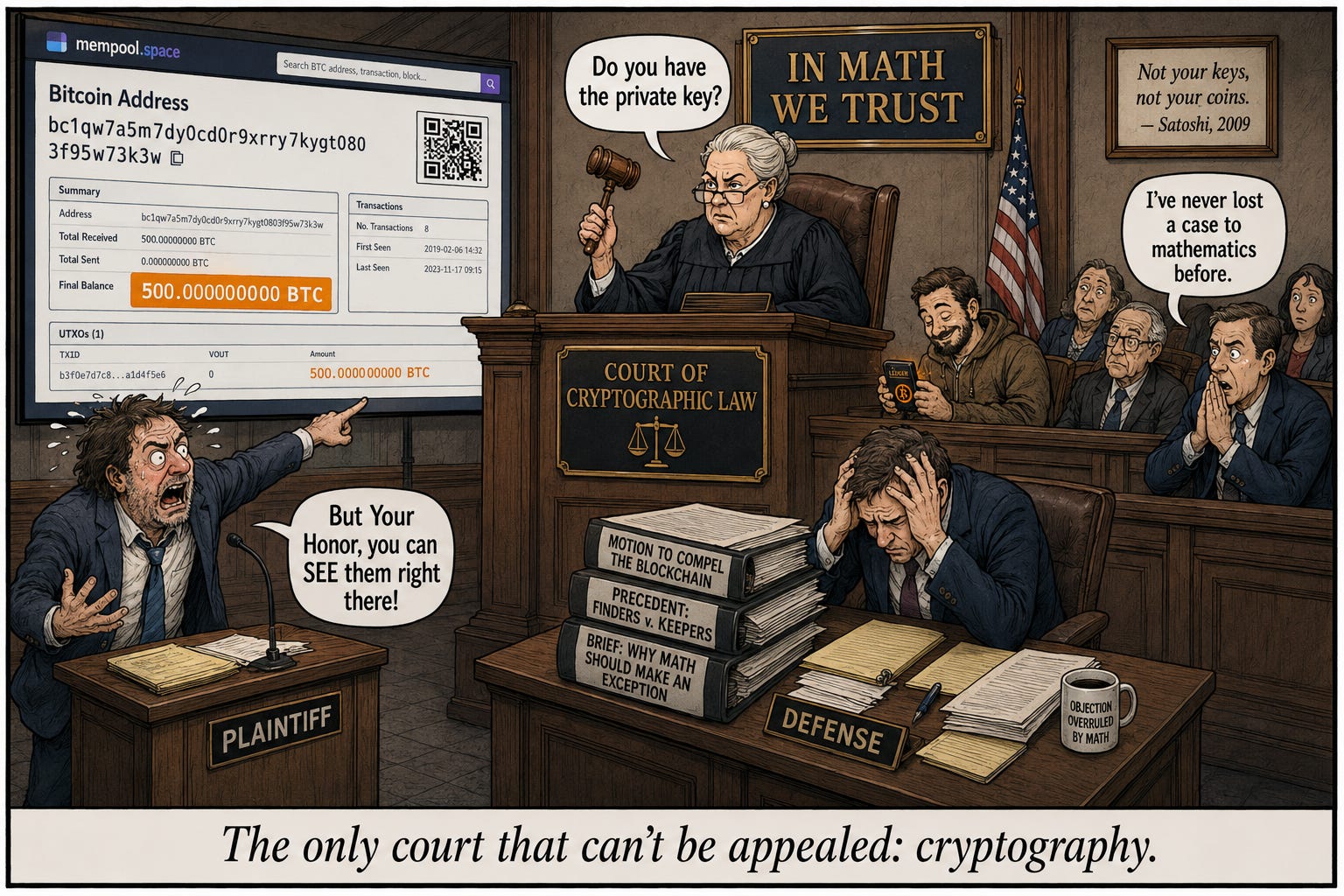
Lost BTC in Court - Someone is petitioning the NY Supreme Court to give them some lost Bitcoin.
lclhost Mining - Localhost Research launched a dedicated Mining Unit.
Silent Amulet - This is a single-file HTML app implementing BIP-352 Silent Payments.
Barcelona Core Dev Meeting - These are transcripts from the May 2026 Bitcoin Core Dev Tech meeting in Barcelona.
Fiat delenda est.