
Bitcoin Tech Talk #508
Interesting Stuff

Century of Humiliation - Greg Johnson draws a parallel between China's “Century of Humiliation” (1839-1949) and America's nascent decline, triggered by the Iran War. His core argument is the conflict was unwinnable from day one and the cascading damage to the petrodollar, Strait of Hormuz trade, and Gulf alliances proved it. The most striking detail is Trump's Beijing summit with Musk as a symbol of desperation which trades Taiwan access and AI technology to China for help escaping the quagmire. China emerged as the primary beneficiary of the Iran conflict without firing a single shot. Trump’s plan here is the logical end of seeing fiat money as the ultimate weapon which is well past its heyday.
European A/C - Ghost of Arthur Powell eviscerates Europe's ideological resistance to air conditioning, showing how it’s a civilization-level failure where political posturing literally kills people. Only about a quarter of French housing has air conditioning, and the 2003 heat wave killed an estimated 70,000 Europeans, which is far more than US gun-related deaths. The most absurd anecdote is about how a London resident was forced by planning inspectors to permanently remove two AC units, with the suggested alternative being to open windows at night. The people most alarmed about rising temperatures are the same ones blocking the most effective technology for surviving them, very similar to their opposition to nuclear power.
Remigration in Practice - Mushkelji writes a coldly analytical taxonomy of five historical approaches to demographic removal, from financial incentives through full state-coordinated expulsion. Denmark's 2022 repatriation program offered $40,000 per refugee to leave and got only 523 takers while thousands continued arriving, suggesting paying people to leave doesn't work at scale. Iran deported Afghan migrants at roughly one million per month in 2025 using a combination of rewards and punishment. The author's core thesis is that effectiveness correlates with state willingness to use violence and how half-measures consistently fail. In other words, the millions that were just let into the country under Biden is unlikely to get solved in any definitive way anytime soon.
Sci-Fi is the Real Literature - John C Wright argues science fiction and fantasy aren't niche genres but the historical norm of storytelling and that mainstream realistic fiction is the actual aberration. He traces realism's dominance to four pillars of Modernist ideology: materialism, pseudo-Darwinism, nihilistic relativism, and Freudian behaviorism. Shakespeare, Homer, and virtually all pre-modern literature naturally included gods, monsters, and prophecy as normal narrative furniture. Imaginative fiction is the literary mainstream and realism is the impoverished corner pretending to be sophisticated. In other words, we’ve been gas-lit by elbow patched literary professors into believing that boring stuff is good, which you can do when you have institutions and fiat money behind you.
China vs India - David Oks argues China's economic success wasn't about freeing markets in 1978 but massive human capital investments during 1950-1976. Literacy jumped 20% to 70%, life expectancy from 41 to 61, and tens of millions of women entered the workforce. India attempted similar reforms but never enforced them. Land reform was evaded through bribery while female labor participation remains 27% versus China's 61%. Between 1987 and 2022, Chinese median income rose 611% while India's rose 88%. The real divergence happened decades before liberalization. In other words, it wasn’t a one-shot quick formula, but a much deeper cultural change that brought about the economic success.
What I'm up to

Overconfidence - I wrote this article about why I’m neither for nor against BIP110 and how that’s the prudent, ossificationist position. Both sides argued that I was being a fence sitter. Guy Swann basically said what I would have said to people on both sides about how they pretty much proved the thesis of the article by their comments, which is that the certainty each side has of the outcome is unfounded and that the intentions are not an excuse for bad results.
CoinTelegraph - This was a short that I recorded at BTC Prague about common questions people have about Bitcoin and some other stuff. Among other things, I predict in it that a lot of the data center power that’s currently being built for AI will inevitably flow to Bitcoin as the AI space speed-runs to ASICs.
Scarcity to Abundance - One of the panels I engaged in from BTC Prague is live! This was about how we should prepare for a civilization that has more abundance and less scarcity. Jeff and Natalie both made the case that it’s going to be really good, and I pushed back saying how abundance in stuff like food and entertainment options have led to epidemics of over-consumption and that abundance is not necessarily always good. It was a fun discussion and if the comments in the video are anything to go by, it definitely hit a nerve.
Nostr Note of the Week

What I’m Promoting
Bitcoin

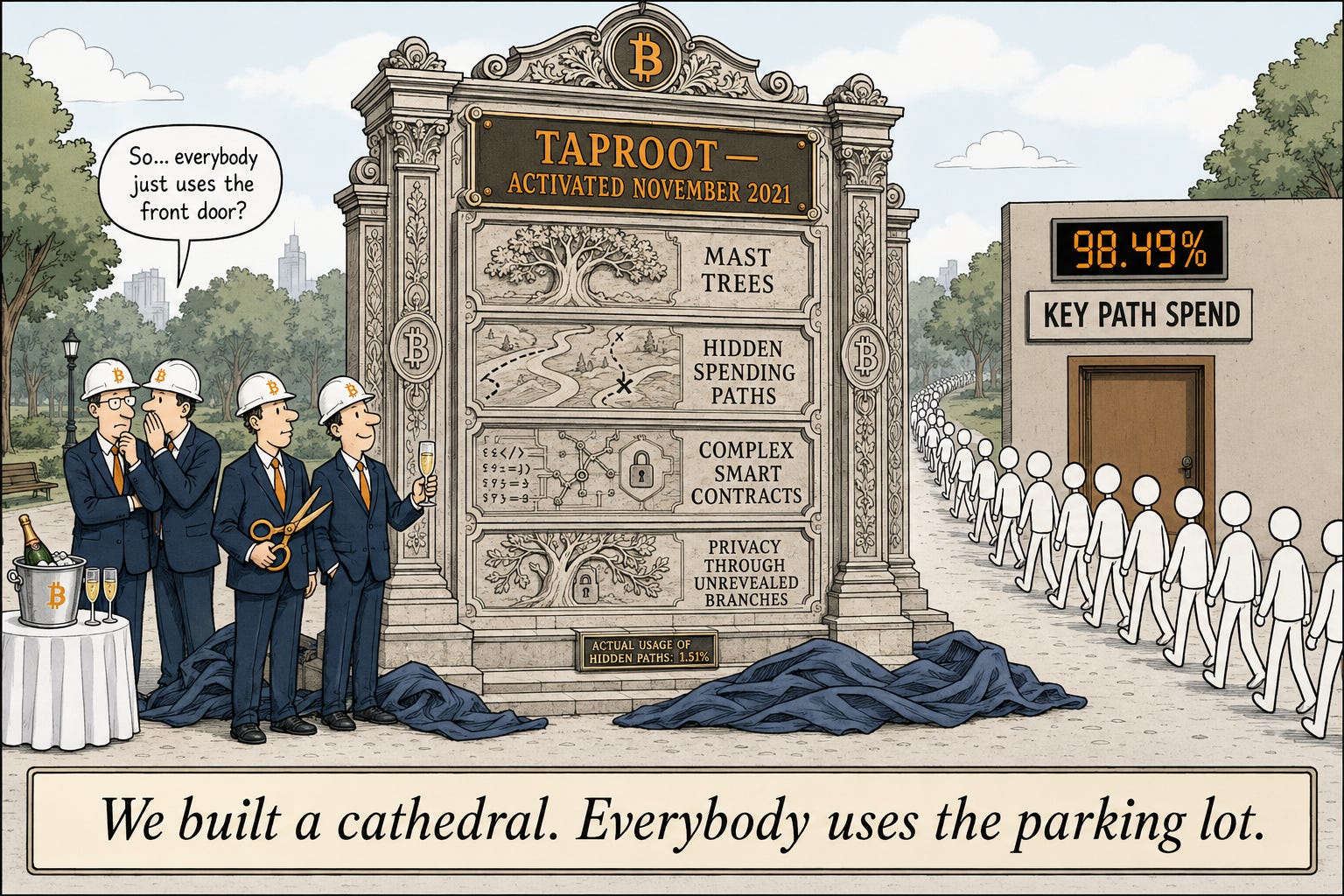
Taproot Analysis - This is a Python script that scans all Taproot script-path spends on mainnet to measure how often people actually use MAST’s hidden spending paths. 98.49% of Taproot script spends had no hidden paths at all meaning only 1.51% used multi-leaf trees with unrevealed branches. The method is deterministic as seen by the control block’s size. MAST’s whole value proposition was enabling complex spending conditions where unused branches remain private and almost nobody is using that capability. It’s been 5 years since this soft fork activated and reflecting on its utility to the broader community is unfortunately in short supply.
BIP110 Readiness - This is a satirical site listing various altcoin protocols and their “readiness” for BIP110. For example, Ordinals has a PR to get around all the BIP110 consensus rules. The implication here is that BIP110’s content filtering would essentially have fought a big fight and expended all this energy for nothing. I don’t think these protocols are quite as ready as they proclaim, as there are likely to be lots of different changes to secondary software needed as well as loads of testing to really be ready. That said, the main lesson to take away from this is that consensus level changes are generally really slow and the opportunity for moves by the opposition can frustrate what the consensus-level changes are supposed to do.
First Miner - This article is a forensic investigation into Bitcoin’s first hours and days, reconstructing who was actually mining in January 2009 using email timestamps, Hal Finney’s debug log, ExtraNonce patterns, and block timing analysis. The key findings challenge common narrative. Hal Finney apparently missed Bitcoin’s launch and didn’t join until around Block 49, not at genesis. When Hal connected, two nodes were already running. The author suspects both belonged to Satoshi. The network experienced eight significant halts in the first 170 blocks, suggesting only one active miner (Satoshi) during those gaps. Dustin Trammell likely ran Bitcoin before Hal but after Satoshi. It’s the most detailed reconstruction of Bitcoin’s fragile first days that I’ve seen, methodically combining email headers, blockchain data, and Bitcoin v0.1 source code analysis.
Lightning
Lightning and the Peptide Industry - Swedish Peptides makes the case for Lightning payments in their industry, where traditional payment processors classify peptide suppliers as high-risk and impose punishing fees. The article covers the usual Lightning selling points like sub-second settlement, minimal routing fees, onion-routed privacy but applies to a real merchant vertical that genuinely struggles with payment rails. It is more theoretical than evidence-based, with no concrete adoption metrics, but the use case is legitimate and the merchant perspective is refreshing. This isn’t the first such industry that will get regulatory resistance on payments and it won’t be the last.
Self-Serve at Voltage - Voltage is killing its self-serve Lightning node hosting to go all-in on enterprise. New provisioning stops July 13 and full shutdown hits August 31, 2026. The company saw roughly 1,000% growth over 18 months from enterprise clients like exchanges, neobanks, and gaming platforms, and decided that split focus was hurting both products. Their argument is that one exchange running on Voltage quietly brings Lightning to millions of users who will never spin up their own node. Pragmatic, but individual node runners just lost an easy on-ramp.
cerberus - Cerberus defines a client-only atomic swap protocol between Bitcoin and Ark VTXOs using adaptor signatures. The Ark server sees only ordinary wallet operations and has no idea a swap is happening. Alice generates a secret scalar, Bob funds a Taproot UTXO with cooperative and refund paths, and the protocol ensures Alice cannot take Bob's BTC without revealing the secret that lets Bob complete the Ark transfer. This is clever cryptographic design with built-in safety. If either party abandons the swap, the other can recover funds.
Economics, Engineering, Etc.

BIP110 Position Taxonomy - Murray Rudd maps the BIP110 debate across two different axes. Monetary maximalism vs data usage on one axis and Results vs rights positions on the other axis. Six distinct ideological communities emerge rather than the usual binary framing. He identifies monetary minimalists, neutrality pragmatists, layer-building expansionists, ossification conservatives (me), miner-economics advocates, and macro-monetary voices, all with conflicting remedies despite shared sound-money values. The key insight is that sound-money beliefs do not automatically translate into support for consensus-level content filtering.
Bitcoin Is Not Freedom - A contrarian piece from the Mises Institute arguing that Bitcoin alone does not constitute freedom and that the narrative of “digital escape” from state control is ultimately a delusion. The article challenges Bitcoiners to think more critically about what sovereignty actually requires beyond holding a cryptographic asset. Coming from an Austrian economics outlet that is typically sympathetic to Bitcoin, this carries more weight than the usual mainstream criticism. Worth engaging with even if you disagree.
Reflections on Block Size - Jameson Lopp revisits the block size war with the benefit of hindsight, having advocated for both sides at different points. He distills it to one question: optimize for cheap transactions or cheap verification? His key takeaway is that governance matters more than technology. For him, the small-block victory proved that miners and companies cannot force rule changes on unwilling users. But he gives Roger Ver partial credit too, acknowledging that Bitcoin did shift away from everyday payment utility. He expects similar ideological battles to recur as new participants arrive with different priorities.
Quick Hits
Consensus Cleanup Opposition - This is a hub for the community against BIP54, the proposed “Consensus Cleanup” soft fork.
The Secret History of Polymarket - Whitney Webb and Mark Goodwin argue that Polymarket is a Pentagon program.
Bitkit Watch - This is a slick browser-based watch-only wallet.
Nordic Bitcoin Treasury Companies - An autopsy of seven Nordic Bitcoin treasury companies.
Fiat delenda est.