
Bitcoin Tech Talk #511
Interesting Stuff
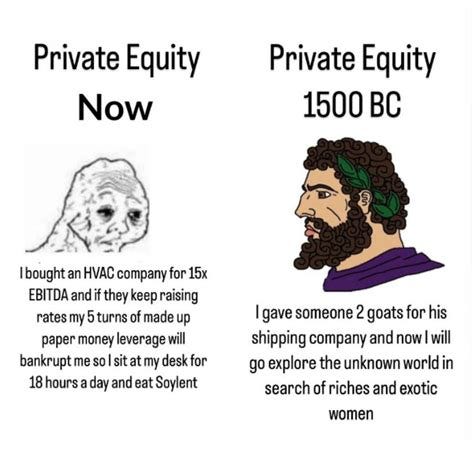
Everything is Private Equity - Hanna Horvath writes about how private equity has quietly infiltrated roughly 20% of the American economy, buying up everything from day cares to emergency rooms, loading companies with debt, and systematically degrading quality while maintaining prices. The statistics she cites are scary. PE-owned nursing homes show 10% higher mortality and PE emergency rooms 13% higher death rates. Fiat money continues its takeover of the economy, which started with large, public companies and has progressed down to small business. The playbook is pretty straightforward. Central banks flood the system with liquidity, financial engineers use it to buy real assets, strip them for parts, and extract rents from captive consumers who don’t even know who owns the services they depend on. The enshittification everyone complains about is just leveraged buyouts if you go back far enough.
Post-Scarcity and the Beast Of Revelation - Will Manidis follows the surprising Silicon Valley trend of interpreting Revelation given the current tech trends. In it, he makes the argument that the post-scarcity utopia tech bros keeps promising us is actually the system described in Revelation, where identity, money, and permission to trade all collapse into a single administrative authority. He argues that the mark of the beast made literal through biometric IDs like WorldCoin. The piece draws a sharp line from Genesis, where Adam names creation and exercises meaningful dominion, to Babylon, where the beast replaces names with numbers and work with dependency. The main takeaway for me is that abundance without agency isn't paradise and is much more akin to a prison.
Leverage Research - Lydia Laurenson writes this wild story that was set to appear in The New Yorker before it was pulled, presumably because of how crazy it sounds. A bunch of Bay Area effective altruists are funded by Peter Thiel try to hack consciousness without guardrails and ended with members reporting demonic entities, paranoid "intention wars," and full-blown cult dynamics. The founder maintained power over employees' housing, visas, and romantic lives while pursuing increasingly esoteric bodywork techniques that left participants with PTSD and panic attacks. Even if you doubt the existence of spiritual reality, this story will surely give you some food for thought.
China and Housing - Graham Stephan shows how China's real estate collapse has wiped out roughly $18 trillion in household wealth. The core problem is one Bitcoiners have been warning about for years, which is that using anything other than a monetary asset to save will significantly distort that asset’s price. Something like 70% of a nation's household wealth is concentrated in housing, was propped up by government policy and the current, inevitable correction is catastrophic. Prices have fallen for 35 consecutive months back to 2006 levels, major developers have defaulted on over $300 billion in debt, and 1.5 trillion yuan in mortgages are tied to apartments that were never finished. This is what happens when supply outruns demand via fiat money.
Putin’s Perspective - Kulak writes insightfully about how Putin is conducting the Ukraine war. He is playing what’s called Kutuzov's long game, a strategy from the Napoleonic Era where deliberate military restraint and simple waiting crushed Napoleon’s army. This is a bit of a foreign concept in the West and looks like cowardice, but there’s a cold logic to it that makes sense. He’s waiting for the West's financial house of cards to collapse under its own weight. American political cycles demand quick wins and dramatic moves, while Russia can afford to hold defensive lines for years, banking on Europe's energy crisis and unsustainable debt levels to eventually cut off Ukrainian support. Whether or not you buy the analysis fully, the underlying point about Western fiscal fragility determining geopolitical outcomes is one that should resonate with anyone watching sovereign debt levels.
What I'm up to

Ideals and Incentives - My talk from BTCPrague is out and it’s about how we treat miners versus developers. We treat one as only motivated by money and the other as only motivated by ideals. I think that’s a mistake and a realistic view of both would be beneficial to the ecosystem. And of course, the AI-generated version with Korean audio is already here.
Bitcoin Historico - This is a X Spaces chat I had with Max, Stacy and Jethro last year, which is out as a podcast episode. We talked about how Bitcoiners should be thinking a lot more long-term, which is what the conference is all about. I will be speaking again at the event in San Salvador this November.
Nostr Note of the Week

