
Bitcoin Tech Talk #512
Interesting Stuff

Warm Countries Are Poorer - Tomas Pueyo makes a compelling argument that equatorial poverty is about geography. It turns out that the heat nearer to the equator mean heat and disease which results in more people seeking the coolness of mountains. Then the crushing transportation costs and ethnic fragmentation results in a much less productive society, compared, to, say, cities and countries that have more maritime trade. Readers of Thomas Sowell will be familiar with this sort of argument, which leaves to geography what is typically blamed on colonialism. The insight that air conditioning may be one of the greatest poverty-alleviating inventions ever underscores how much human flourishing depends on solving real engineering problems rather than redistributing fiat money.
The Nudge Unit - David Shipley exposes Britain's RICU aka, "the nudge unit" that psychologically manipulates victims' families into parroting state-approved messaging. The RICU isolates victims from each other and uses cult-like relationship-building tactics to maintain control over the victims’ public statements. The blatant propagandistic tactics are truly despicable, as they hold the prospect of a mistrial over the families of the victims to get them to comply. The fact that this unit’s original mission of counter-terrorism transitioning to targeting mainstream conservative commentators tells you everything about where the regime sees the real threat.
Warfighting ability - Scott Locklin cuts through all the elaborate foreign policy theorizing with one brutally simple metric about a country’s warfighting ability. A country’s warfighting capacity can be accurately approximated by tons of steel produced per year. It's the kind of heuristic that engineers come up with, versus the complicated and useless metrics that credentialed foreign policy elites come up with in their rent-seeking. The implication for American foreign policy is sobering. You would think the US would make an order of magnitude over what Iran produces in steel. Not so, US only leads Iran by 82 to 32 tons per year. When you've spent decades financializing your economy and offshoring industrial capacity, your ability to sustain a real war shrinks no matter how many think-tank papers you publish.
Power Theory - Dimes pushes back against simplistic "one cabal rules everything" elite theories, arguing instead that power is a distributed "prevailing wind" across competing institutions, intelligence agencies, and criminal networks that cooperate and conflict in messy, transactional ways. The Epstein case serves as his prime exhibit. The lines between intelligence operatives, financial elites, and criminals are effectively nonexistent, which is less a conspiracy and more the natural result of power concentrating wherever accountability is absent. It's a useful framework for understanding why the bureaucratic fiat system persists. No one group controls it all and benefits, but every powerful actor benefits just enough from the status quo to keep it going.
Everything Feels Scammy - Elisabeth Stone perfectly captures the modern consumer experience with an anecdote. She bought a printer but couldn't print without a subscription. You no longer "own" movies as much as have some long-term rental until the service faces financial pressure. Every transaction is engineered to extract maximum recurring revenue rather than deliver honest value, which is one modern way companies have found to fight inflation. Instead of charging more now and causing sticker shock, they put in sneaky monthly charges to make sure that their older sales keep paying. The erosion of trust she describes is really the erosion of integrity that comes when sound money no longer disciplines businesses into honest dealing.
What I'm up to
Messy Middle - I wrote about what I think will happen come August 8 or 9th when the BIP110 mandatory signaling period begins. Both sides are counting on a single chain favoring their side, while my prediction is that it’ll be something much messier and in-between. I lay out the implications of this unprecedented scenario in the article.
Y’all Street - The interview was with a precious metals audience so my arguments were much more specific to what makes Bitcoin a better money than gold. Goldbugs are a natural ally against the Federal Reserve and usually ideologically aligned. Yet it’s often pretty difficult to get them to take Bitcoin seriously, if for no other reason than momentum, so I tried to address a lot of that in this interview.
Nostr Note of the Week

What I’m Promoting
Bitcoin

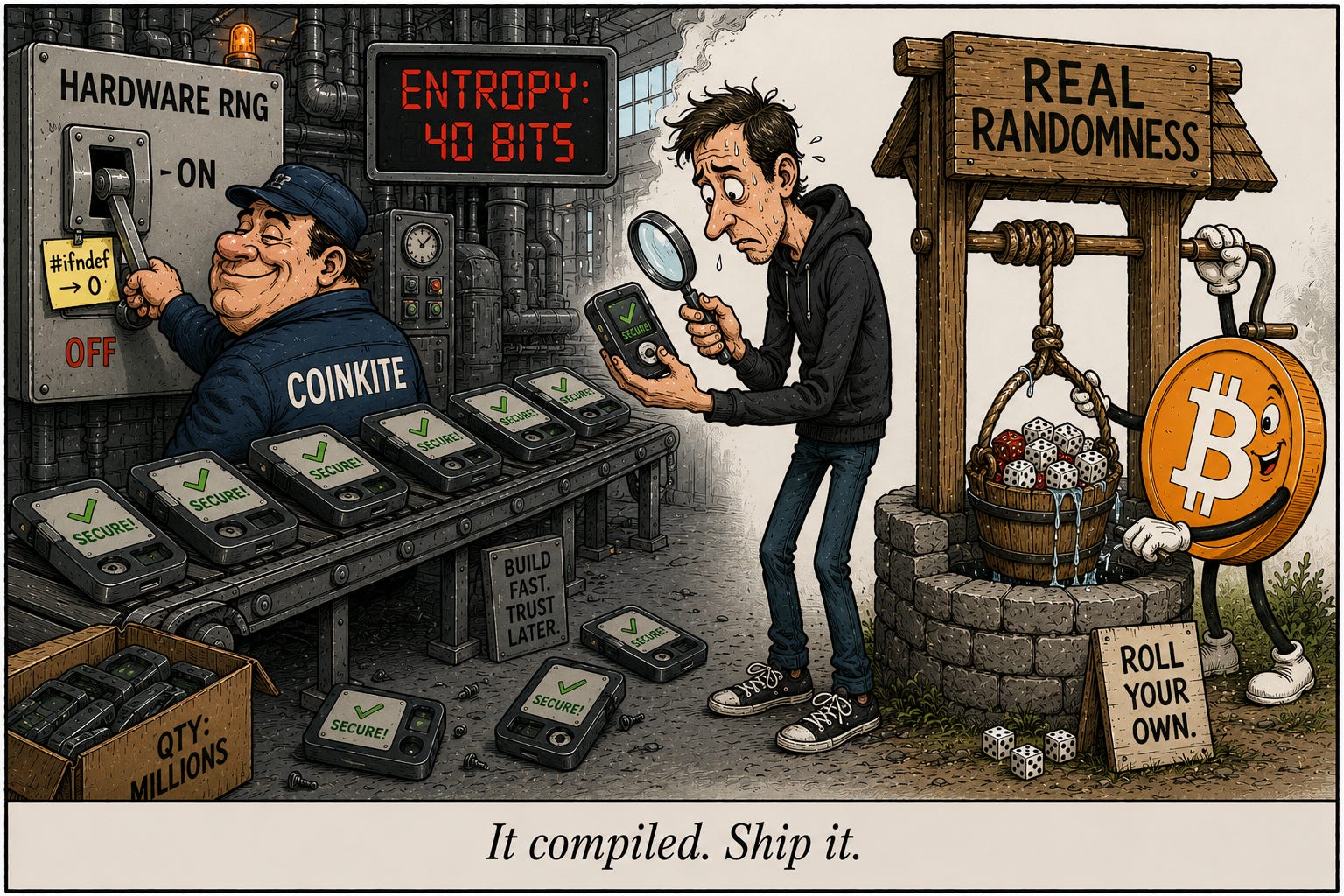
Coldcard RNG Flaw - Wizard Sardine delivers the definitive technical breakdown of the Coldcard RNG disaster. A compilation flag set to zero silently routed seed generation through a narrow deterministic PRNG instead of the hardware RNG, leaving Mk2/Mk3 wallets under firmware 4.0.1 and above with a pathetic 40 bits of entropy since 2021. The fix is not a firmware update as existing seeds are permanently compromised and users must generate entirely new wallets and sweep funds immediately. If you imported the seed, you should be okay, but if you had a ColdCard generated seed, no matter which version of the ColdCard you have, you should move your coins. Block also published their analysis as did BTCPP. There’s now a site to watch for the movement of these vulnerable Coldcard seeds. Coinkite also had their official response.
DropKick - DropKick proposes an elegant commit/reveal scheme for rescuing bitcoin from quantum-vulnerable legacy addresses, using knowledge asymmetries that honest key holders possess but quantum attackers cannot derive. The protocol is simpler than competing approaches like LifeBoat as there are no complex zero-knowledge proofs required, though it trades simplicity for longer delay periods and proportional fee payments to miners as a censorship-resistance mechanism.
Bitcoin Mempool Linearization - This academic paper introduces Spanning Forest Linearization (SFL), an algorithm for optimally ordering transactions in Bitcoin mempools to maximize fee-rate efficiency while respecting dependency constraints. SFL outperformed competing approaches on both synthetic and real mempool data and has already been integrated into Bitcoin Core for cluster linearization. This ColdCard stuff withstanding, fees are still fairly low so this is optimizing a very minor aspect of real miner revenue, but should be something that makes a bigger difference as fee markets emerge.
Lightning

CLINK in Opencart - This OpenCart extension lets merchants accept Lightning payments using the CLINK protocol, which routes payment communication through Nostr relays instead of traditional payment processor APIs. No intermediary, no KYC chokepoint, no rent-seeking middleman. Just cryptographic identity and direct settlement, which, from a merchant perspective, is exactly how commerce should work. The support for both one-time payments and subscription auto-renewals via nDebit shows that Bitcoin's payment infrastructure is maturing enough to start to compete with legacy processors.
Predicting Channel Closures - Researchers tried to predict Lightning Network channel closures using machine learning and found that simple neural networks outperformed fancy graph models. Behavioral signals like node activity history ended up being the strongest predictors. The most interesting finding is actually a privacy win: the models performed only moderately well because the most important data like channel balances, payment flows, and uptime are private by design in the gossip protocol. Lightning's architecture makes surveillance hard even for sophisticated ML, which is great news.
l402.space - This is a universal proxy gateway that lets you pay for any 402-gated API using your preferred payment method. This can be L402 via Lightning, x402 via USDC, or MPP. This is one version of the HTTP 402 “Payment Required” status code finally being put to its intended use after decades of sitting dormant. Lightning as the native payment rail was always envisioned to make micropayments actually viable. By bridging multiple payment protocols, this gateway lowers the barrier for developers to monetize APIs without subscriptions or ads. We’ll see if this direct challenge to the surveillance-advertising business model gets traction.
Economics, Engineering, Etc.

Krackpot and the Public Mempool - Krackpot lets anyone point their browser's GPU at Bitcoin Puzzle 71, a 6 BTC bounty from 2015. The big update is that winning transactions now go through a private channel like SlipStream instead of the public mempool to prevent front-running. This has been a huge use-case for many of the compromised ColdCard users, who didn’t want to be RBF’d once their transactions hit the mempool. On the one hand, I’m happy that there’s none of the MEV-style stupidity happening in public like there is in Ethereum, but I’m also concerned that this sort of thing locks in miner centralization.
Bitcoin Miners and AI - Bitcoin miners are pivoting to AI because mining economics have become brutal, with public miners selling 32,000 BTC at a loss in Q1 2026 to fund the transition. The real asset is not the hardware but the grid-connected, permitted land that AI companies desperately need, since utility interconnection queues stretch 5-7 years. While this sucks while the AI money is abundant, there will also be an AI bust, which should put Bitcoin miners that can survive this bear market in a great position to capitalize when this capacity comes back.
ColdCard Passport Connection - Zach Herbert of Foundation, the creators of Passport, details how he thinks the ColdCard’s weak random number generation came about. He shows how according to their git history, the main impetus was Foundation using ColdCard code to make their own hardware wallet. CoinKite (makers of ColdCard) immediately moved to transition away from the GPLv3 license, which was inherited from ColdCard’s usage of Trezor’s GPLv3 code. The argument is pretty compelling as none of the seeds generated on the ColdCard before this transition seem to have been compromised.
Quick Hits
Transaction Rate-limiting - The old per-peer transaction rate limiter has been replaced with a global system using dual token buckets.
Balaji's Network School - Malaysia revoked the business license of Balaji Srinivasan's Network School.
Silent Payments - BIP352 Silent Payments is now in libsecp256k1
Vida Pays in Lightning - Vida Global, an Austin-based AI company, started paying employees in Bitcoin over Lightning.
Fiat delenda est.