
Interesting Stuff

How to Rule the World - Ted Gioia exposes “Rule” which is a secretive 12-student Stanford course connected to Effective Altruism and propaganda tactics. The most famous known student is one Phoebe Gates, daughter of Bill, who is now alleged to have done some illegal shenanigans at her startup Phia. Effective Altruism is a philosophy that lets the credentialed class rationalize immoral behavior by using some unseen, long term utilitarian argument and it’s troubling that the same philosophy that gave us Sam Bankman-Fried and Elizabeth Holmes is being used to train people who will inevitably become compromised. EA is a form of fiat morality and just like fiat money, it’s doing way more damage than the theoretical good it purports to do.
The Post-Trump Future - Aaron M. Renn games out four post-Trump governing coalitions: left-populist, left-technocrat, moderated MAGA, and Trumpless Trumpism and writes about how likely each will be. He concludes, depressingly, that the Obama-style neoliberal technocracy is the most likely to reassemble a durable majority. The most important idea in the piece is what he calls “American Liquidationism.” Every faction is committed to sacrificing future prosperity to keep the Boomer benefits flowing. That's the inevitable endgame of fiat money, which is that you can always take out more debt to service the present and sadly, no political faction is willing to forego such a powerful, though unjust, tool.
Thick Things - Adam Mastroianni argues that great art has many layers of meaning that only reveal themselves through sustained effort, or what he calls “thickness.” His main example is the hidden musical notation in the art piece, Bosch's Garden of Earthly Delights that took people decades to find, decode, interpret and re-interpret. He contrasts this with AI slop and Twitter-popularized self-help platitudes. They are cheap to produce and have nothing underneath. Thick art is low time preference culture and it survives centuries because someone poured real work into it. In a sense, the easy, thin and meaningless art is indicative of a fiat civilization where engagement is high time preference.
Nike's Downfall - Ethan Strauss chronicles how Nike, the company that built an empire on Michael Jordan and the masculine will to dominate, now markets to a very different audience. Activist middle managers (Karens) fresh from the universities pushed the iconic brand into preachy gender-first restructuring, and leadership capitulated rather than fight. The result was that the company traded its actual revenue base of men for a theoretical “Undecided Whale” of female consumers. It's a case study in woke/fiat corporate culture. They optimized for internal HR peace over the customers who made them, and the ads got terrible accordingly. What’s even more surprising about this piece is that it was written 5 years ago, and Nike has done worse and worse doing the same things from the article.
On Orban - Bronze Age Pervert contrasts Lee Kuan Yew's Singapore with Orban's Hungary. Orban, despite total institutional control, managed only 2% growth, brain drain, and a patronage economy funneling its youth into low-value assembly work while Singapore managed 8-9% growth for decades. The warning for American conservatives is that cultural grievance without genuine competence-building is a dead end. He also notes that controlling institutions means nothing if you use them to reward friends instead of cultivating talent. The deeper lesson is that governance quality, like sound money, reveals itself over a long period of time. Low time preference statecraft compounds, while patronage politics is just another way of eating your seed corn.
What I'm up to
Market Disruptors - I spoke with Jake Roque about a whole host of different things. The most interesting part for me was the discussion on fiat debt as theft and why I no longer have any credit cards or any other loans (including a mortgage). The argument is based on Christian ethics and the reality of central-bank backed fiat money, and it’s one I believe most Christians don’t take seriously.
Holy Seed Meetup Part 2 - This was part two of the meetup I did in Seoul. Thanks to AI, I was able to get a good idea of what people were asking even if they were speaking Korean, and similarly, the audience was able to see my response translated in real time. Mostly, we spoke about that intersection between Bitcoin and Christianity, though there were some questions about startups and other things.
Nostr Note of the Week

What I’m Promoting
Bitcoin

The Ark Protocol - Elle Mouton delivers a genuinely excellent technical walkthrough of Ark. Elle explains how VTXOs let many users share a single on-chain UTXO via a tree of pre-signed transactions, with a collaborative spend path through the operator and a unilateral exit path if the operator misbehaves. The key design principle is that you never give up your sats before verifying exactly what you're getting back, which keeps it self-custodial. The catch is that VTXOs expire, so as she puts it, the tradeoff is not custody, it's that you cannot “set and forget.” Ark is one of the more promising Layer 2 designs precisely because it preserves unilateral exit, and if you want to actually understand it instead of just repeating the marketing, this is the piece to read.
Bitcoin post-quantum R&D - Conduition's Brink engineering call gives a useful map of the post-quantum landscape. There are new output types like BIP-360's P2MR and P2TR variants, quantum canaries and tripwires to detect when Q-day is actually near, Hourglass-style rate-limiting of vulnerable legacy coins, and commit/reveal recovery schemes backed by hash-based, lattice-based, and isogeny-based signatures. The main takeaway for me is that everything here involves ugly tradeoffs between signature size, efficiency, and complexity, and needless to say, nothing has consensus or is even close to consensus-ready.
Dice to Seed - Keith Mukai of SeedSigner has put together the definitive reference on generating Bitcoin seeds from dice rolls, covering 17 implementations with source-level verification. He clears up the persistent myth that casino-grade dice are necessary, since even cheap plastic dice with sub-2% bias cost you maybe 2-3 bits out of 256. The real gotchas are elsewhere like different devices using different constructions (hashed, bit-packed, base-6). Two wallets will only agree on the same rolls if they use the same method, which is why he stresses cross-verifying with throwaway rolls against tools like iancoleman.io before trusting a device. This is a great way to understand how and why dice rolls are used for seed generation and the mechanics behind it.
Lightning

Nested Threshold Multisig - This paper tackles the operational problem of Lightning channels being 2-of-2 multisig. This is fine for individuals, but is awkward for businesses, families, and inheritance setups who want t-of-n threshold custody rather than a single hot key controlling their channel funds. The proposed approach nests threshold signing inside each channel party, so “t” key shares collectively acts as one side of the 2-of-2. This brings multisig security to Lightning channels without the counterparty needing to know or care. Single hot keys on always-online Lightning nodes have been one of the reasons why there aren’t bigger transactions on there, so threshold custody may unlock some different use-cases for Lightning, especially in the higher value realm.
Glimpse - Glimpse bills itself as the first regulated prediction market where event contracts are denominated and settled entirely in Bitcoin over Lightning. The main advantage of Lightning is that you can have instant deposits and withdrawals, which other platforms have difficulty executing without a ton of fraud. They are regulated by the Bermuda Monetary Authority, and have qualified custody through BitGo. Prediction markets are changing the nature of news and no doubt, they want to get into this game with this market differentiator. Whether they’ll have sufficient liquidity to matter is another story entirely.
Authenticity - This is a visualization dashboard that shows Lightning payments flowing across the network in real time. They also show node health metrics, giving operators a live window into what their channels are actually doing. Lightning has always suffered from being a bit of a black box compared to on-chain Bitcoin, so tools that make routing activity and node performance legible are a real service to the people keeping the network decentralized. Of course, this has been something that many tools have tried to solve with dashboards and so on, but it’s a bit of a limited market, so I don’t know how good the UX will get.
Economics, Engineering, Etc.

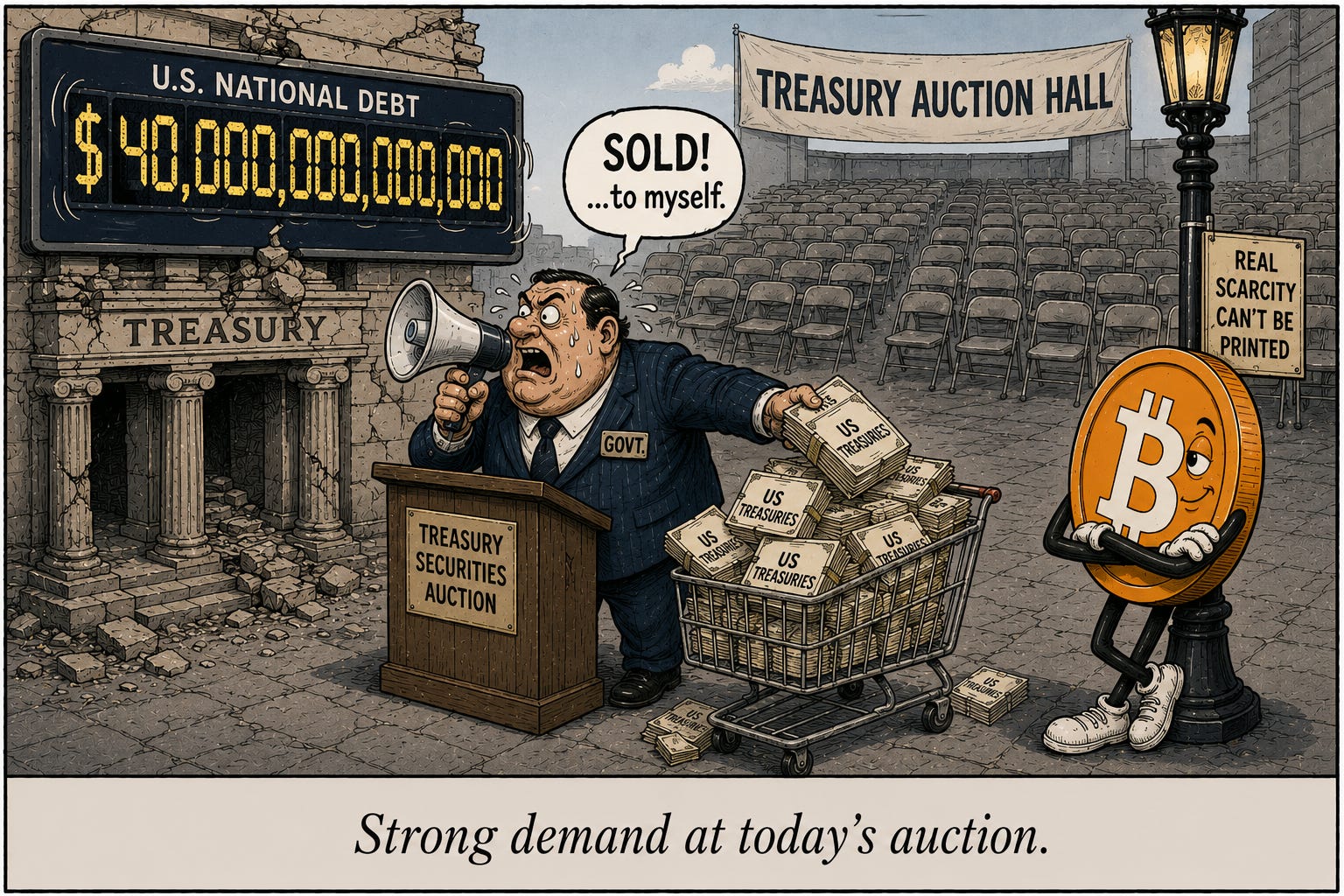
$40,000,000,000,000.00 - The US national debt just blew past $40 trillion, the same week that Bessent committed to buying more treasuries. The narrative around the Bitcoin price rise this week was based on these two events, suggesting that people are getting more skeptical of the US government’s ability to make good on that debt. That is, that the USD will continue holding reserve currency status and have enough demand to justify the continuous printing. Whether this is really the correct narrative, or is the bounce off the bear market bottom is hard to say, but what’s clear is that the dollar is not nearly as strong as it used to be and the high interest rate of treasuries is becoming a big problem both economically and politically.
BIP-110 Post Mortem - Jameson Lopp dissects the failure of BIP-110, which set a lowered 55% miner activation threshold and peaked at 2.5% signaling. The lessons are, for him, that activation mechanisms can't conjure consensus that doesn't exist, which I mostly agree with. The bigger problem was that there wasn’t a price for the two sides of the fork and that lack of information is ultimately what doomed the effort. Miners essentially had an unknown economic incentive to switch, which given their scale, meant that they were going to go with the status quo.
Vinteum’s First Cohort - Vinteum reports on the first cohort of its Bitcoin Dev Launchpad, an intensive program shepherding developers into open-source Bitcoin contribution. The results are encouraging with multiple alumni landing OpenSats grants and others joining Boltz, Lightning Labs, and Tether's QVAC project. The lesson they emphasize is that there's no single timeline into Bitcoin open source. Real outcomes emerge a long period of time, not overnight. It’s especially good to see this effort happening in Brazil and not, say the usual places.
Quick Hits
First Recoverable Grant - The first “recoverable grant” Geyser campaign funded an espresso machine for the Haven food court.
Future of HWI - They will finish MuSig2 support then freeze all new features and device support while transitioning to the successor BHWI.
Nic and Bitcoin Maximalism - Nic Carter is back with another eulogy for maximalism, with disingenuous arguments having been chastised years ago for his altcoinery.
River’s Accounting - River threw out their traditional ledger system and replaced it with two functions, deriving account state from a Bitcoin-like immutable history of events.
Unlukey - You can check whether your wallet address matches datasets of known weak-randomness vulnerabilities
Fiat delenda est.